
Introduction to AI Tools
Artificial Intelligence (AI) tools represent a significant advancement in technology, tailored to enhance various aspects of daily operations across numerous industries. These tools leverage machine learning, data analytics, and automation to process information efficiently, facilitating quicker decision-making and optimizing workflow processes. AI tools can be found in numerous applications such as customer service, data management, marketing, and human resources, revolutionizing methods that organizations engage with clients and manage internal tasks.
The significance of AI tools is underscored by their power to transform how businesses operate. By integrating AI systems, companies can analyze vast datasets in real-time, uncovering patterns and insights that were previously unattainable through conventional analysis methods. This capability not only leads to better strategic decisions but also enhances overall efficiency, allowing employees to focus on higher-value tasks rather than mundane responsibilities. For instance, AI-powered chatbots in customer support can handle inquiries 24/7, drastically reducing response times and improving customer satisfaction.
Moreover, the integration of AI tools into daily routines fosters a workspace that is not only more productive but also more streamlined. By automating repetitive tasks, employees can devote their time and skills to more creative and innovative ventures. This not only boosts morale but also drives a culture of continuous improvement, as teams can iteratively refine their workflows using insights garnered from AI analysis.
As the workforce continues to evolve, embracing AI tools becomes crucial. Organizations that adopt these technologies stand to gain a competitive edge, capitalizing on data-driven insights to innovate and enhance service delivery.
Must-Have AI Tools for Productivity
In today’s fast-paced environment, utilizing AI tools has become essential for enhancing productivity across various domains. Here are some must-have AI tools that can significantly improve your efficiency in task management, scheduling, and content creation.
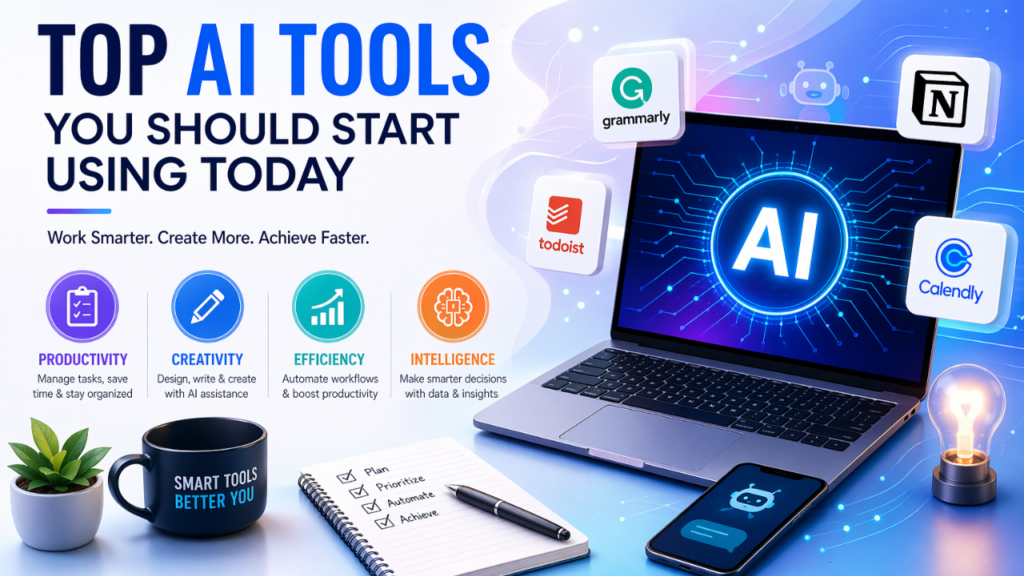
1. Todoist: This task management app employs AI to learn your habits and optimize your to-do lists. With features like task prioritization, deadline reminders, and integration with other services, Todoist transforms how you organize your tasks. By leveraging its intelligent scheduling capabilities, users can plan their day more effectively, ensuring that high-priority tasks get completed.
2. Calendly: As a scheduling tool powered by AI, Calendly simplifies meeting setups by automatically detecting available time slots. It removes the back-and-forth game of finding a suitable meeting time, allowing users to share their calendars, set preferences, and let others book appointments seamlessly. This efficiency ensures that valuable time is spent on more critical tasks rather than scheduling mishaps.
3. Grammarly: For content creation, Grammarly is an indispensable AI writing assistant that enhances writing quality. Its advanced algorithms not only check grammar and punctuation but also provide real-time suggestions for clarity, engagement, and delivery. Writers can expect to improve their written communication significantly, whether it’s emails, reports, or creative pieces.
4. Notion: This all-in-one workspace integrates task management, note-taking, and document collaboration, making it a favorite among teams. Notion’s AI enhancements help in automating repetitive tasks, organizing data tables, and mapping project workflows, thus providing a coherent platform for productivity optimization.
By incorporating these AI tools into your daily routines, you can witness a remarkable boost in productivity. Each tool offers unique features that cater to various needs, ensuring that whether it’s managing tasks, scheduling appointments, or enhancing writing, there is an AI solution available for you.
Cutting-Edge AI Tools for Creative Professionals
In the rapidly evolving landscape of technology, creative professionals are increasingly adopting artificial intelligence tools to enhance their workflows. These AI solutions offer innovative features that not only streamline processes but also inspire new forms of creativity across various domains, such as design, music production, and writing.
One of the notable AI tools for designers is Adobe Sensei. This powerful platform incorporates machine learning and analytics to optimize design tasks like image editing and layout adjustments. By automating repetitive tasks, Adobe Sensei allows designers to focus on ideation and creativity, thus elevating the overall quality of their work. Additionally, tools like Canva leverage AI to provide design suggestions based on user preferences, making graphic design accessible even for those without extensive training.
In the realm of music production, AIVA (Artificial Intelligence Virtual Artist) stands out as an innovative tool. AIVA utilizes deep learning algorithms to compose original music across various genres. This tool is particularly beneficial for composers seeking inspiration or rapid prototyping of musical ideas. By generating unique tracks tailored to specific requirements, AIVA enables creative professionals to explore new musical landscapes with ease.
Writers, too, can benefit from the rise of AI-driven tools. Grammarly and Jasper are examples of writing assistants that employ artificial intelligence to improve grammar, style, and coherence. These platforms analyze text in real-time, offering suggestions that enhance clarity and engagement. Writers relying on these tools can thus ensure their content resonates better with their audience.
As these examples illustrate, integrating cutting-edge AI tools into creative processes can empower professionals to push boundaries and achieve higher levels of innovation. By adopting these technologies, creative individuals can unlock new potential, refining their craft while enhancing productivity.
Future Trends in AI Tools
The landscape of artificial intelligence continues to evolve at an unprecedented pace, leading to the development of innovative tools that redefine how businesses operate. Future trends in AI tools are likely to focus on enhanced automation, improved data integration, and increased accessibility for a broader range of users. One significant trend is the integration of AI with Internet of Things (IoT) technologies, which will allow for smarter decision-making based on real-time data from interconnected devices. This synergy could revolutionize industries such as healthcare, manufacturing, and logistics.
Moreover, advancements in natural language processing (NLP) are expected to transform how we interact with AI. Tools that can understand, interpret, and generate human-like text will not only improve customer service interfaces but also lead to more effective content creation and data analysis. As AI language models become more sophisticated, their application will extend into areas such as automated journalism, where they can produce written content based on real-time events.
Another vital trend is the rise of explainable AI (XAI), which focuses on creating AI systems that can offer transparency in their decision-making processes. As AI technologies become more pervasive, users will increasingly demand insights into how AI-derived conclusions are reached. This shift toward explainability is vital for fostering trust and ensuring ethical utilization of AI tools.
Finally, the democratization of AI tools will allow smaller organizations to benefit from advanced technologies previously available only to large corporations. With more user-friendly platforms emerging, businesses of all sizes can leverage AI to boost efficiency and remain competitive in an ever-changing market. As we look ahead, staying informed about these emerging trends will be crucial for professionals seeking to harness AI’s full potential.